The Six Essential Stages of Building a Robust AI Agent

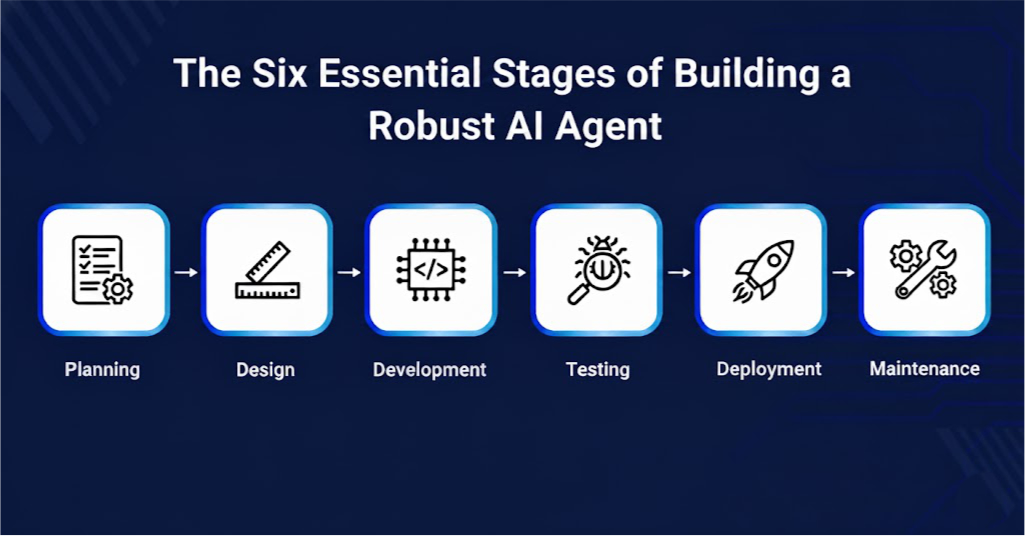
When I first started building conversational AI, I quickly learned that the success of an AI Agent isn't determined by the coolness of the underlying model. It’s about discipline. Specifically, it’s about adhering to a structured development process. For anyone looking to deploy reliable, high-performing agents, whether you wear the business suit or write the code, you must master the following six stages. This is my playbook for turning an idea into a functioning, revenue-generating system.
1. Planning: Setting the Strategic North Star
This is the most crucial, yet most often rushed, phase. As a business manager, if you don't dedicate serious time here, you're setting the entire team up for failure.
- Draft Business Needs: In my experience, the biggest mistake is saying "we need AI because everyone else has it." We must precisely define the business pain we are solving. For the developer, this step translates directly into the non-negotiable functional and non-functional requirements (security, scalability, speed) that will guide the build.
- Define Agent Objectives: This is our Key Performance Indicator (KPI)! From a business standpoint, this means defining success metrics: Will it save us 20% on support costs? Will it increase conversions by 5%? For the engineering team, these metrics dictate the entire architecture—do we optimize for low latency or maximum accuracy?
- Resource Allocation: Don’t underfund your cloud compute budget. The manager must ensure enough budget is set aside for the expensive GPU usage during fine-tuning and inference. Developers need this clarity to choose models and services within budgetary constraints.
- Risk + Ethics Review: Reputational damage and legal fees are the most expensive failures in AI. The business must preemptively identify legal and ethical pitfalls. The developer uses this review to integrate necessary safety-mechanisms like content moderation filters and toxicity checks right from the start.
2. Design: Building the Agent’s DNA
Once the strategy is clear, we move to the blueprints. This is where we create the agent’s unique characteristics and limitations.
- Design Guardrails: This is our insurance policy against bad behaviour. Business-wise, guardrails guarantee the agent stays on-brand and avoids generating toxic or non-compliant responses. The developer implements these as system prompts and layered security filters that strictly limit the agent's actions and output.
- Grounding With Context: This is what turns a generic LLM into our expert. The manager understands this makes the agent useful in a specific domain. The developer’s task is to select and structure the knowledge base, often using Retrieval-Augmented Generation (RAG) to ensure the agent uses proprietary, factual data.
- Select a model: We must resist the urge to use the largest, most expensive model by default. Business needs require balancing high performance with cost-efficiency. The developer performs essential benchmarking to choose the model that provides the best trade-off between speed, accuracy, and API costs.
- Choose a Framework: Time-to-market is often dictated by the framework. Using established tools like LangChain or Semantic Kernel accelerates development. The developer needs this decision to orchestrate the complex chain of reasoning and tool-use efficiently.
3. Development: The Engine Room
This is the phase everyone thinks of when they hear "AI project," but it’s only meaningful if the first two stages were solid.
- Build the Agent Logic: The cleaner the logic, the fewer headaches we’ll have later. The developer designs the critical decision loop (observe, reason, act, tool-use). From a managerial view, clear logic means faster debugging and lower maintenance costs.
- Integrate the models: Expect unexpected delays here due to API incompatibilities and latency issues.The developer connects the various specialized models (LLM, vector DB, third-party APIs) and ensures they communicate reliably.
- Fine-tune Models (If Required): This is a costly operation that must be justified by clear business goals.The business manager approves the expense only if performance gains (like tone or accuracy) are required. The developer is responsible for the meticulous process of data collection, cleaning, and model training.
- Document Setup: This is the boring, but utterly essential step. As an author, I can’t stress enough how crucial good documentation is for long-term project survival. It's the developer’s manual for deployment, maintenance, and future iterations.
4. Testing: Breaking the Agent to Make It Stronger
We are not looking for confirmation that it works; we are actively trying to break it.
- Test Edge Cases: We must seek out the scenarios that could cost us money or ruin our reputation. The developer uses stress-testing, fuzzy inputs, and adversarial attacks to find the system's limits.
- Conduct User Experience Tests: If the user can’t get an answer easily, we’ve failed, regardless of the agent's accuracy. The business focuses on the user journey and satisfaction. The developer uses this feedback to optimize the dialogue flow and response time.
- Perform Integration Tests: We must ensure the agent doesn't just work in a sandbox, but within our entire operational ecosystem (CRM, databases). The developer tests end-to-end processes.
- Evaluate Performance: This is the final checkpoint to see if we hit our original KPIs. The business reviews the performance metrics against the initial objectives to determine readiness for launch.
5. Deployment: The Moment of Truth
The agent is live. This phase is characterized by intense monitoring and risk mitigation.
- Launch Agent: I highly recommend a phased, gradual rollout (A/B testing or limited access) to minimize the blast radius of any unexpected bug. The developer handles the CI/CD pipeline, pushing the code to the live environment.
- Make sure Guardrails are working: The first few hours are critical for security. The business manager monitors real-time logs for any ethical or security breaches that could go viral.
- Observability: You cannot fix what you cannot see. The developer must have robust monitoring tools (like Prometheus or Grafana) configured to provide real-time metrics on performance, usage, and errors.
- Compliance Validation: The final legal stamp of approval. The business ensures adherence to all regional and industry regulations (e.g., GDPR).
6. Maintenance: The Long Game
Deployment is not the end; it's the start of the marathon.
- Act upon User feedback: User feedback is our most valuable dataset for iteration. The manager prioritizes the backlog based on user complaints and suggestions. The developer implements fixes and feature requests based on this input.
- Optimize Operations: This is where we fight for every cent in the cloud bill. The developer continuously improves model efficiency, caches responses, and reduces inference costs. The business manager sees the impact on the bottom line.
- Monitor Agent Objectives: The ultimate question: Is the agent still providing business value? The manager and developer collaboratively monitor long-term KPIs (accuracy, speed, cost) to determine if the agent remains a valuable asset or needs a complete overhaul.

MindPlix is an innovative online hub for AI technology service providers, serving as a platform where AI professionals and newcomers to the field can connect and collaborate. Our mission is to empower individuals and businesses by leveraging the power of AI to automate and optimize processes, expand capabilities, and reduce costs associated with specialized professionals.
© 2024 Mindplix. All rights reserved. A product by Axisway