Practical Analysis of Compact AI Systems for Local LLM Deployment (2025)

Introduction
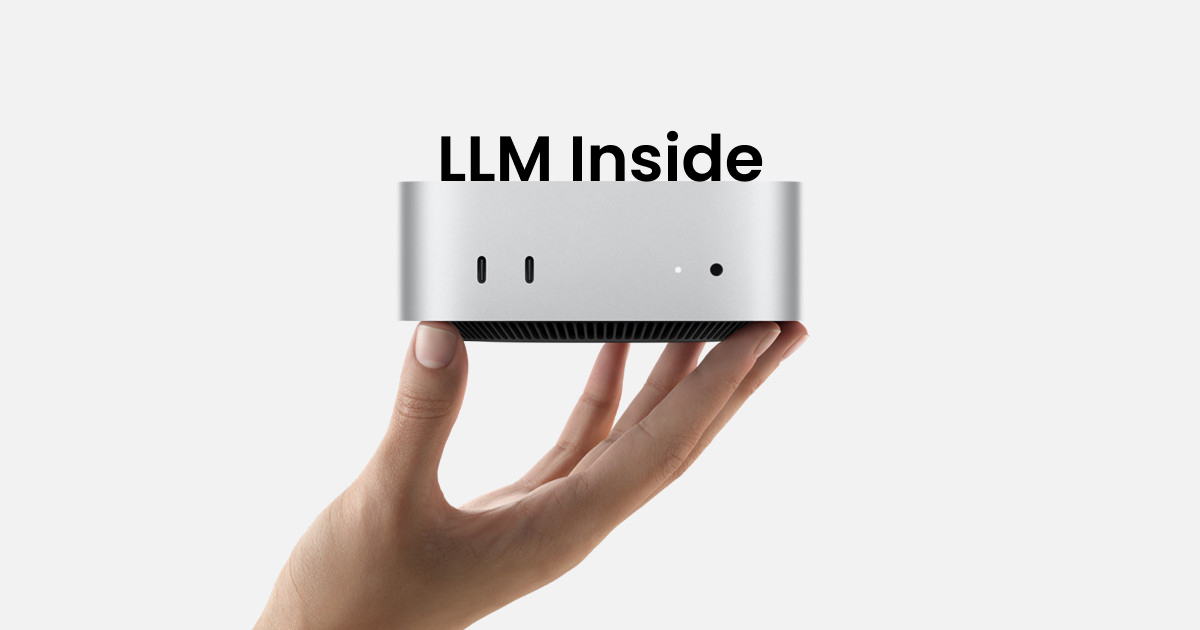
Today, it is possible for startups, developers, and research laboratories to run large language models (LLMs) on local machines. This will probably be even more common in 2025 with the advent of compact AI computers and powerful desktops. Candidates for the purpose include Mac Minis, Mac Studios, Nvidia DGX Spark, Asus Ascent GX10, and AI-driven Ryzen systems from Beelink, Acemagic, and Morefine. This report analyzes the systems for modern open-source LLMs deployed at locally run machines on the basis of price, performance, energy efficiency, and suitability.
General Selection Logic
When determining the proper hardware for either fine-tuning or inference of LLMs, three main factors should be considered:
- First is the size and speed of memory. LLMs require large unified or GPU memory to be efficiently loaded, and the weights determining the parameters of the memory must be accounted.
- Secondly, the value for computation performance (in FLOPS/TOPS… etc) must meet the requirements for inference time and scaffolding of quantized models for adjusted RAM.
- Lastly, the energy and resource expenditure scalability must correlate to the size of the expected workload. That especially matters for run time and continuous workload. Desktops are more comprehensive and cost efficient for most businesses compared to dedicated server-class AI systems.
Hardware Comparison

1) PC with Nvidia RTX 5090
- Price: about $4,000
- Memory: 64 GB DDR5 + 32 GB VRAM
- Release: 2024–2025
- Power: ~550–700 W
- Performance: estimated 50–100 TFLOPS FP16
- Suitable LLMs: GPT-NeoX 20B, Falcon 40B (partial), LLaMA 70B (quantized)

2) Mac Studio M4 Max
- Price: from $3,329
- Memory: 128 GB unified
- Release: March 2025
- Power: 145W under full load
- Performance: estimated 38 TFLOPS AI equivalent
- Suitable LLMs: Yi-VL-66B, Llama 3 70B Instruct, Qwen 2 57B (MoE), Mixtral 141B, DBRX 132B (quantized ~FP16)

3) Mac Mini M4
- Price: about $2,199
- Memory: 64 GB unified
- Release: October 2024
- Power: 65W under full load
- Performance: lower GPU throughput than Studio
- Suitable LLMs: Mixtral 47B, Qwen 2 32B, DeepSeek-Coder 33B, Llama 32B

4) Nvidia DGX Spark
- Price: $3,999
- Memory: 128 GB unified LPDDR5x
- Release: 2025
- Power: 240 W
- Performance: up to 1 PFLOP FP4
- Suitable LLMs: Bloom 176B, YaLM-100B, LLaMA 70B, Falcon 40B

5) Asus Ascent GX10
- Price: $2,999
- Memory: 128 GB unified
- Release: mid-2025
- Power: 240 W PSU
- Performance: ~1 PFLOP FP4/1000 TOPS
- Suitable LLMs: Bloom 176B, YaLM-100B, LLaMA 70B, Falcon 40B

6) Dell Pro Max GB10
- Price: $3,000–4,000
- Memory: 128 GB LPDDR5x unified
- Release: 2025
- Power: 280 Watt
- Performance: ~1 PFLOP FP4
- Suitable LLMs: Bloom 176B, YaLM-100B, LLaMA 70B, Falcon 40B

7) Acer Veriton AI
- Price: approx. $3,999
- Memory: estimated 128 GB unified
- Release: 2025
- Power: 240 W
- Performance: ~1 PFLOP FP4 (expected)
- Suitable LLMs: Bloom 176B, YaLM-100B, LLaMA 70B, Falcon 40B

8) Orange Pi AI Studio Pro
- Price: $1,900–2,200
- Memory: up to 192 GB LPDDR4X
- Release: October 2025
- Power: 240W
- Performance: ~352 TOPS (~0.35 TFLOPS)
- Suitable LLMs: GPT-NeoX 20B, Falcon 40B (limited), LLaMA 70B (quantized)

9) Morefine H1
- Price: $2,099
- Memory: 128 GB LPDDR5X-8000
- Release: 2025
- Power: 320 W PSU
- Performance: ~50 TOPS (~0.05 TFLOPS)
- Suitable LLMs: GPT-NeoX 20B, Falcon 40B (quantized)

10) Beelink GTR9 Pro
- Price: $1,985
- Memory: 128 GB RAM
- Release: 2025
- Power: ~140 W TDP
- Performance: ~126 TOPS (~0.12 TFLOPS)
- Suitable LLMs: GPT-NeoX 20B, LLaMA 70B (quantized)

11) Acemagic F5A Ryzen AI 9 HX370
- Price: $649–1,019
- Memory: up to 128 GB DDR5
- Release: September 2025
- Power: 54 W TDP
- Performance: ~80 TOPS (~0.08 TFLOPS)
- Suitable LLMs: GPT-NeoX 20B, LLaMA 70B (limited)
Profitability and Feasibility Conclusions
- Desktop AI setups (Mac Mini, Mac Studio, custom PC) are ideal for development, model quantization, and small-scale inference.
- Compact AI servers (DGX Spark, GX10, GB10, Veriton AI) deliver enterprise-grade throughput suitable for models above 100 B parameters.
- Ryzen AI-based mini-PCs (Beelink, Morefine, Acemagic) balance efficiency and mobility but cannot handle top-tier models without compression.
- Price-to-performance ratio is highest in Asus GX10 and DGX Spark, offering PFLOP-class compute under $4 000.
Budget and upgrades
Thanks to its brand visibility, a tightly controlled peripheral ecosystem, and trade-in programs, the Mac option scores the most points in residual value and long-term utility. Longevity potential and trade-in or reuse value also rate quite highly. For instance, some trade-in values for specific Mac models are even higher now than they were prior to the latest model launch.
Within the same budget range, higher performance and comparable iDell Pro Max GB10m, ASUS Ascent GX10's market value and performance placement comes with higher marketplace and technical obsolescence risk. As market demand for used high-end AI desktops becomes unpredictable, the risk of rapid hardware turnover due to market demand will destabilize the performance value of the system.
There is significant market potential with dual card RTX 5090 systems, but high-risk, low predictability due to under-layer systems (power, cooling, PCIe lanes, motherboard/graphics card interface) will detract from future market potential.
For long-term investment, the Resale value, Mac brand ecosystem, and longevity potential are junior highly correlated systems. Simple value within a risk investment indicates that high predictability within the system will justify residual market value.
Energy cost matters
Nvidia DGX Spark, Asus Ascent GX10, and Dell Pro Max GB10 clearly lead in raw performance, each reaching around 1 PFLOP while maintaining moderate power consumption near 240–280 W. This gives them the best overall ratio of compute per watt and makes them the most efficient options for deploying large LLMs such as Bloom 176B or YaLM-100B.
Among energy-efficient systems, the Mac Mini M4 and Acemagic F5A Ryzen AI 9 HX370 stand out, consuming only 65 W and 54 W respectively while handling small to mid-scale models like GPT-NeoX 20B. In sum, the DGX Spark is the top performer per watt in high-end computing, while Mac Mini M4 delivers the best energy efficiency for lightweight local deployments.
Final Summary
For hobbyists and early-stage startups, Mac Mini M4 or Ryzen AI mini PCs offer low entry cost and adequate power for small LLMs. For teams targeting models ≥ 70 B, Mac Studio M4 Max or a GTX 5090 PC provides better flexibility. For professional AI developers, Nvidia DGX Spark and Asus Ascent GX10 currently represent the most balanced all-in-one PFLOP-class machines under $4 000, capable of running the largest open-source models like Bloom 176B or YaLM-100B locally.

MindPlix is an innovative online hub for AI technology service providers, serving as a platform where AI professionals and newcomers to the field can connect and collaborate. Our mission is to empower individuals and businesses by leveraging the power of AI to automate and optimize processes, expand capabilities, and reduce costs associated with specialized professionals.
© 2024 Mindplix. All rights reserved. A product by Axisway